Barbell Calculator
Type any target weight, or tap plates onto the bar. See exactly what goes on each side. In lb or kg.
This free barbell calculator shows which plates to load on each side of the bar for any target weight, in lb or kg. It also works as a barbell plate calculator: tap the plates already on the bar and it adds up the total. Total = bar + (plates on one side x 2). On a 45 lb bar, two 45 lb plates per side is 225 lb. Pick your bar, switch off plates your gym does not own, and read the load straight off the bar.
A barbell weighs the bar plus two matching stacks of plates. On a standard 45 lb (20 kg) men’s bar, two 45 lb plates on each side make 225 lb. The calculator above does that math for any weight, in lb or kg, and shows what to load.
Key takeaways
- Always add the bar. Four 45 lb plates are 180 lb. The lift is 225 lb.
- “Two plates” means two per side. Two 45s a side is 225 lb, three is 315 lb, four is 405 lb.
- 45 lb is not 20 kg. 45 lb is 20.41 kg, and 20 kg is 44.09 lb.
- Not every bar is 45 lb. Women’s bars, trap bars and EZ bars differ. Read the stamp.
- Competition collars add 5 kg. A men’s bar with collars is 25 kg before plates.
How to use the barbell calculator
- Pick LB or KG first. The bar and the plate set change with the unit. This barbell calculator then loads the matching plates.
- Choose your bar. 45 lb (20 kg) is the men’s bar and 35 lb (15 kg) the women’s bar. For anything else, type its real weight in the bar field.
- In Enter weight, type the total you want, including the bar. The plates per side appear on the bar, biggest plate nearest the collar.
- Switch off plates your gym does not have, like 55 lb or 1.25 kg. Most gyms stock 45, 35, 25, 10, 5 and 2.5 lb plates, and some also have 55 lb bumpers. The calculator solves again with what you own.
- Want to build it by hand? Use Tap to add. One tap puts a plate on both sides and the total updates.
- Percent table scales a weight from 50 to 100 percent. Warmup sets gives bar only, 50 percent for 5, 70 percent for 3, 85 percent for 1, then your working weight. Tap Load on any row.
- If your exact number cannot be loaded, you see the closest load under it and the next one up.
Barbell calculator or plate calculator: is there a difference?
A barbell plate calculator is a tool that converts a target total weight into the plates to load on each side of the bar. No. A barbell calculator, a barbell plate calculator, a plate loading calculator and a barbell weight calculator all turn a total weight into plates per side, or add up the plates already on the bar. Only the name changes between gyms and apps. Searching “plate calculator” alone can also bring up steel plate weight tools for engineers, which have nothing to do with lifting. What does differ is the help around the math. This tool also scales weights with a percent table, builds warmup sets, counts collars and lets you switch off plates your gym does not have.
Common barbell loads: plates per side from 135 to 405 lb
These are the numbers lifters chase, on a 45 lb bar. “A plate” is one 45 lb plate per side: one plate is 135 lb, a plate and a quarter is 185 lb, and a plate and a dime is 155 lb.
| Total | Per side | Plates per side | In kg |
|---|---|---|---|
| 95 lb | 25 lb | 1 × 25 | 43.1 kg |
| 135 lb | 45 lb | 1 × 45 | 61.2 kg |
| 185 lb | 70 lb | 1 × 45 + 1 × 25 | 83.9 kg |
| 225 lb | 90 lb | 2 × 45 | 102.1 kg |
| 275 lb | 115 lb | 2 × 45 + 1 × 25 | 124.7 kg |
| 315 lb | 135 lb | 3 × 45 | 142.9 kg |
| 365 lb | 160 lb | 3 × 45 + 1 × 25 | 165.6 kg |
| 405 lb | 180 lb | 4 × 45 | 183.7 kg |
| 455 lb | 205 lb | 4 × 45 + 1 × 25 | 206.4 kg |
| 495 lb | 225 lb | 5 × 45 | 224.5 kg |
How many plates per side? Quick answers.
- One plate means one 45 lb plate per side: 135 lb. Two plates is 225 lb, three is 315 lb, four is 405 lb.
- A plate and a 25 is 185 lb. A plate and a dime (10 lb) is 155 lb. Two plates and a 25 is 275 lb.
- With a 35 lb women’s bar, two 45s per side is 215 lb, not 225.
- 100 kg on a 20 kg bar needs 40 kg per side: 25 + 15, or 20 + 20. With competition collars it needs 37.5 kg per side, for example 25 + 10 + 2.5.
- 45 lb is 20.41 kg and 20 kg is 44.09 lb. A 45 lb bar with two 20 kg plates per side is 221.4 lb.
- Machines are different. Leg press sleds and Smith machine bars have their own weight and often a counterbalance, so check the machine before comparing it to a free barbell.
Common barbell loads in kg
On a 20 kg bar, largest plates first. The same total can be built several ways, so turn off plates your rack lacks and the calculator reshuffles. For 100 kg, 25 + 15 and 20 + 20 both work.
| Total | Per side | Plates per side | In lb |
|---|---|---|---|
| 40 kg | 10 kg | 1 × 10 | 88.2 lb |
| 60 kg | 20 kg | 1 × 20 | 132.3 lb |
| 80 kg | 30 kg | 1 × 25 + 1 × 5 | 176.4 lb |
| 100 kg | 40 kg | 1 × 25 + 1 × 15 | 220.5 lb |
| 120 kg | 50 kg | 2 × 25 | 264.6 lb |
| 140 kg | 60 kg | 2 × 25 + 1 × 10 | 308.6 lb |
| 160 kg | 70 kg | 2 × 25 + 1 × 20 | 352.7 lb |
| 180 kg | 80 kg | 3 × 25 + 1 × 5 | 396.8 lb |
| 200 kg | 90 kg | 3 × 25 + 1 × 15 | 440.9 lb |
How much does a barbell weigh?
Most gym bars are the men’s 45 lb (20 kg) bar, but the stamp on the sleeve end is the only proof. A women’s bar with two 45s a side is 215 lb, not 225.
| Bar | lb | kg | Note |
|---|---|---|---|
| Men’s Olympic bar | 45 | 20 | Standard in most gyms and in IWF and IPF competition. |
| Women’s Olympic bar | 35 | 15 | The competition women’s bar is 15 kg. |
| Technique or training bar | about 15 | about 7 to 10 | Varies a lot. Read the stamp. |
| EZ curl bar | 15 to 25 | 6.8 to 11.3 | Varies by brand. |
| Trap (hex) bar | 45 to 75 | 20 to 34 | Check the model. |
| Safety squat bar | 60 to 70 | 27 to 32 | Often heavier than a plain bar. |
lb vs kg: where the numbers drift
A 45 lb plate is not a 20 kg plate. Put 20 kg plates on a 45 lb bar, two per side, and you lift 221.4 lb. Keep one unit per session, or let the tool convert. Here are the exact swaps.
| lb plate | = kg | kg plate | = lb |
|---|---|---|---|
| 45 lb | 20.41 kg | 25 kg | 55.12 lb |
| 35 lb | 15.88 kg | 20 kg | 44.09 lb |
| 25 lb | 11.34 kg | 15 kg | 33.07 lb |
| 10 lb | 4.54 kg | 10 kg | 22.05 lb |
| 5 lb | 2.27 kg | 5 kg | 11.02 lb |
| 2.5 lb | 1.13 kg | 2.5 kg | 5.51 lb |
Plate colors and what they mean
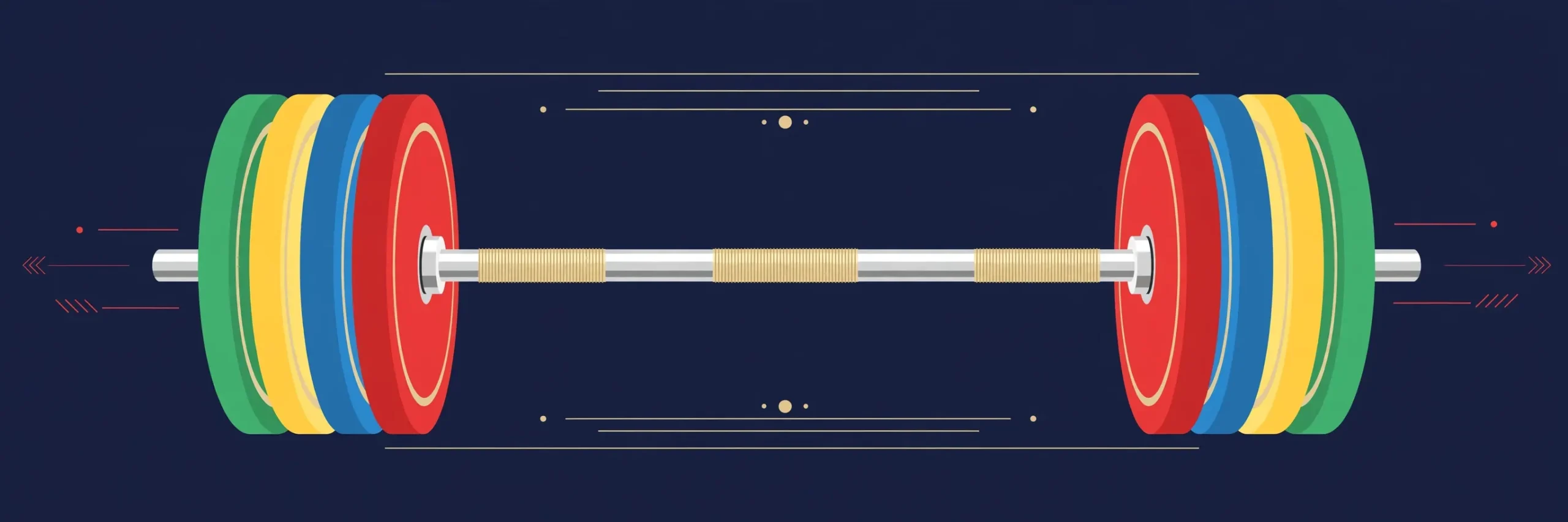
Competition kg plates follow the IWF color code. Gym sets copy the big ones but often change the small plates, so trust the number stamped on the plate, not the paint. Chrome is common for 1.25 kg plates. lb plates have no universal code, but bumper sets copy the competition code for the big plates: 55 lb red, 45 lb blue, 35 lb yellow and 25 lb green, with small plates usually white, black or silver. IPF rules also require discs to be within 0.25 percent or 10 grams of face value, which ordinary gym iron is not.
| Plate | Competition color | Gym sets |
|---|---|---|
| 25 kg | Red | Red |
| 20 kg | Blue | Blue |
| 15 kg | Yellow | Yellow |
| 10 kg | Green | Green |
| 5 kg | White | White |
| 2.5 kg | Red | Often black in powerlifting sets |
| 2 kg | Blue | Change plate |
| 1.5 kg | Yellow | Change plate |
| 1 kg | Green | Change plate |
| 0.5 kg | White | Change plate |
Do collars count?
In competition, yes. IPF and IWF collars weigh 2.5 kg each, so a men’s bar with collars is 25 kg and the platform load is that plus plates. Spring clips weigh almost nothing, so most gym lifters skip them in the math. Use the collar option in the tool when you train to meet standards. Always clip something on.
Percent tables and warmup sets
For a 225 lb working set, 50 percent is 112.5 lb for 5, 70 percent is 157.5 lb for 3 and 85 percent is about 191 lb for 1. Neither 112.5 lb nor 157.5 lb loads exactly with the plates a normal gym has, so the tool rounds each one to the closest load you can build. With 2.5 lb plates the smallest jump is 5 lb. This is one common ramp, not a rule. Adjust it to your program.
Plate math mistakes that mess up your log
Loading the bar safely
Put the heaviest plates closest to the collar, use the same plates on both sides, clip collars on, and count both ends once more before you lift. Use safeties or a spotter for heavy squats and bench. This page is general information, not coaching or medical advice.
Barbell calculator FAQ
How do I calculate barbell weight?
Add the weight of the plates on one side, double it, then add the bar. Total = bar + (plates on one side × 2). On a 45 lb bar with two 45 lb plates on each side that is (90 × 2) + 45 = 225 lb.
How much does an Olympic barbell weigh?
A men’s Olympic bar is 45 lb (20 kg) and a women’s bar is 35 lb (15 kg). Technique bars, EZ curl bars, trap bars and safety squat bars vary by brand, so check the stamp on the sleeve or ask the gym.
How many plates per side for 225, 315 and 405 lb?
On a 45 lb bar with 45 lb plates: 225 lb is two plates per side, 315 lb is three, and 405 lb is four. Add the 45 lb bar to the plates, never forget it.
Is two plates 225 lb or 180 lb?
It is 225 lb. Two 45 lb plates on each side is four plates, which weigh 180 lb, and the 45 lb bar brings the total to 225 lb.
How many plates per side for 100 kg?
On a 20 kg bar you need 40 kg per side, which can be 25 + 15 or 20 + 20. With competition collars (2.5 kg each) you need 37.5 kg per side, for example 25 + 10 + 2.5.
Is 45 lb the same as 20 kg?
No. 45 lb is 20.41 kg and 20 kg is 44.09 lb. The gap looks small but it adds up when you mix lb and kg plates or compare logs across gyms.
Do collars count toward the weight?
In competition, yes. IPF and IWF collars weigh 2.5 kg each, so a men’s bar with collars is 25 kg before plates. Spring clips weigh very little and most lifters ignore them. Pick a collar option in the calculator if you want them counted.
What if my exact weight cannot be loaded?
Your smallest plate sets the smallest jump. With 2.5 lb plates the jump is 5 lb total, and with 1.25 kg plates it is 2.5 kg total. The calculator shows the closest load under your target and the next one up.
How do I work backwards from a total?
Subtract the bar, divide by two, then build that number per side from the biggest plate down. For 275 lb: 275 − 45 = 230, 230 ÷ 2 = 115, and 115 = 45 + 45 + 25 per side.
Does it work for women’s bars, trap bars and EZ bars?
Yes. Choose a preset bar or type the real weight of your bar into the bar field. The plate math is the same for any bar.
Is a plate calculator the same as a barbell calculator?
Yes. Barbell calculator, barbell plate calculator and plate calculator all mean the same tool: it turns a total weight into plates per side. Searching “plate calculator” alone can also return steel plate weight tools, which are unrelated to lifting.
Is the barbell calculator free?
Yes. It is free, needs no signup, and runs in your browser. Your unit, collars and plate choices are saved on your own device only.
About this page
Written by Nazakat, who built this calculator himself. He lifts weights, and the guides were reviewed by Coach Hammad. Every table is calculated by the tool itself and checked against published IWF and IPF equipment standards. Every number on this site comes from a worked example you can check yourself. Last updated November 10, 2026.
How it is built: every table on this page is calculated, not copied. The calculator loads the largest plates first from the plates you enable, and shows the nearest loads when an exact match is impossible. Sources: IWF plate colors, IPF organizing checklist, Barbell on Wikipedia.
Read how the plates are worked out on the About page, and if a load ever looks wrong, tell us through the Contact page.